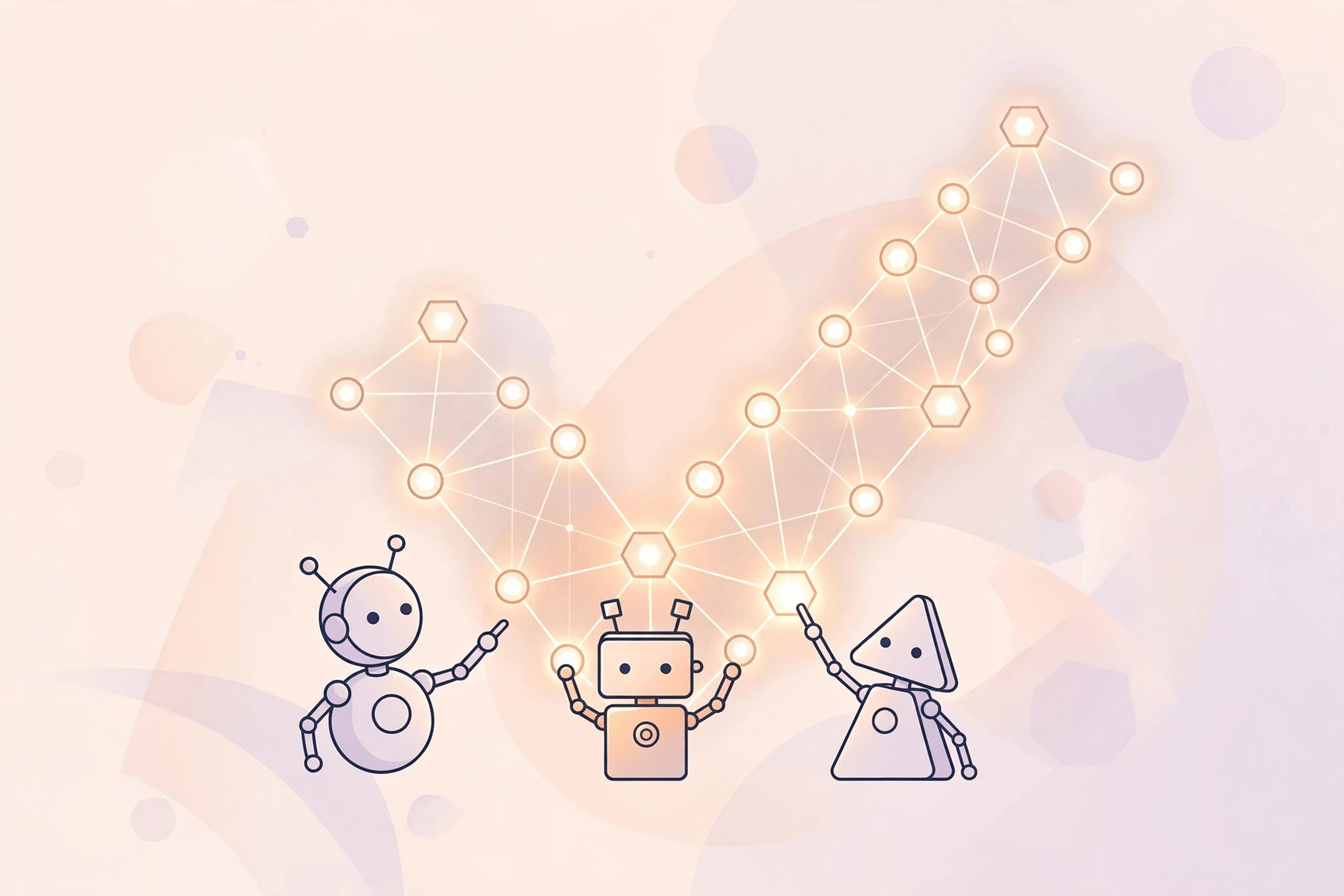
On November 13, 2026, Google Research published what its Antigravity /teamwork multi-agent workflows did over several weeks, running mostly on Gemini 4 Argon with human researchers in the loop. The headline result is a proof of the 2013 Courtade-Kumar conjecture in information theory, in full generality, by researchers from Google, CUHK, USC, and CMU, formalized in Lean 4 at 50 million lines of code. The engineering results may matter more to builders: a two-week campaign rewrote the remaining C++ of the Zircon microkernel into about 800,000 lines of safe Rust, and a Rust rewrite of Google's libgav1 AV1 video decoder ended up 20 to 30 percent faster than the original C++ and hand-optimized assembly. The tools are now open to external researchers and developers.
How /teamwork is built
/teamwork exists because single-model generation has two limits, and Google names both. First, one attempt rarely finds the right answer, so the system pairs parallel exploration with dedicated falsifiers: the Lean 4 proof checker, unmodified test suites, execution simulators, web search, or hardware counters, which automatically verify which candidate solutions work. Second, models lose track over multi-day tasks as context grows, so /teamwork partitions context by construction: each specialized agent gets only the exact files and tools it needs, coordinators hand off to fresh successors, and critics and auditors challenge results from clean contexts without the producer's reasoning. The workflows are declarative natural-language patterns, from distributed coding to long-proof and document review, and /boost packages the iterative solve-and-verify loop for day-to-day coding. Google even reports a harness optimizing another harness: a long-running campaign found that tightly coupled code is best handled sequentially rather than split in parallel, and fed that back into /boost.
The results, with the receipts checked
Start with the proof. The Courtade-Kumar formalization is public, audited, and machine-verified: an independent check counted about 239,000 lines of readable proof code, with the rest generated certificate data that the Lean kernel checks mechanically, anchored to a 63-line formal statement. Google also reports a machine-checked formalization of the Weil conjectures, but unlike Courtade-Kumar it has no public repository linked yet, so treat that one as reported, not independently checkable. The engineering receipts are stronger. The Zircon port passes all kernel unit tests and boots on arm64 hardware. The libgav1 port reached 100 percent bit-exact parity across a broad conformance suite, started about 4 times slower than the C++ original, and finished 20 to 30 percent faster once the agents got profiling tools and a mandate to maximize speed. A hill-climbing team trained a 9x9 Go engine from scratch and gained roughly 2,600 Elo in under eight days, reaching 1,885 Elo. And in peer review, Deep Review covered 578 STOC 2027 submissions, with 90 percent of surveyed authors rating the feedback mostly or almost all factual and over 30 percent saying it caught substantive proof bugs or significant typos.
How to use it, and what to copy
External scientists and developers can use Gemini 4 models with /teamwork and /boost in Antigravity today on paid plans, and Google has opened applications giving 10,000 academic researchers six months of free access to its highest usage tier. The part worth copying is not the model, it is the harness: verify every step with an objective checker, keep each agent's context small and specific, and let a fresh auditor challenge the result instead of asking the producer to check its own work. Our n8n AI agent guide covers the same loop at small-team scale, including the iteration cap that stops any agent from running forever on your bill, and our Claude Fable 5.2 explainer covers the planner side of a planner-and-worker split. If you want the agent setup, the spend alerts, and the monitoring around it checked by someone who runs infrastructure for a living, book a free infra audit with DevOpsBY.
Disclaimer: This post is educational only, not financial advice. Figures are as reported by the sources on 2026-11-17 and may change - always confirm version numbers, requirements, and prices in the official docs before acting on them.